


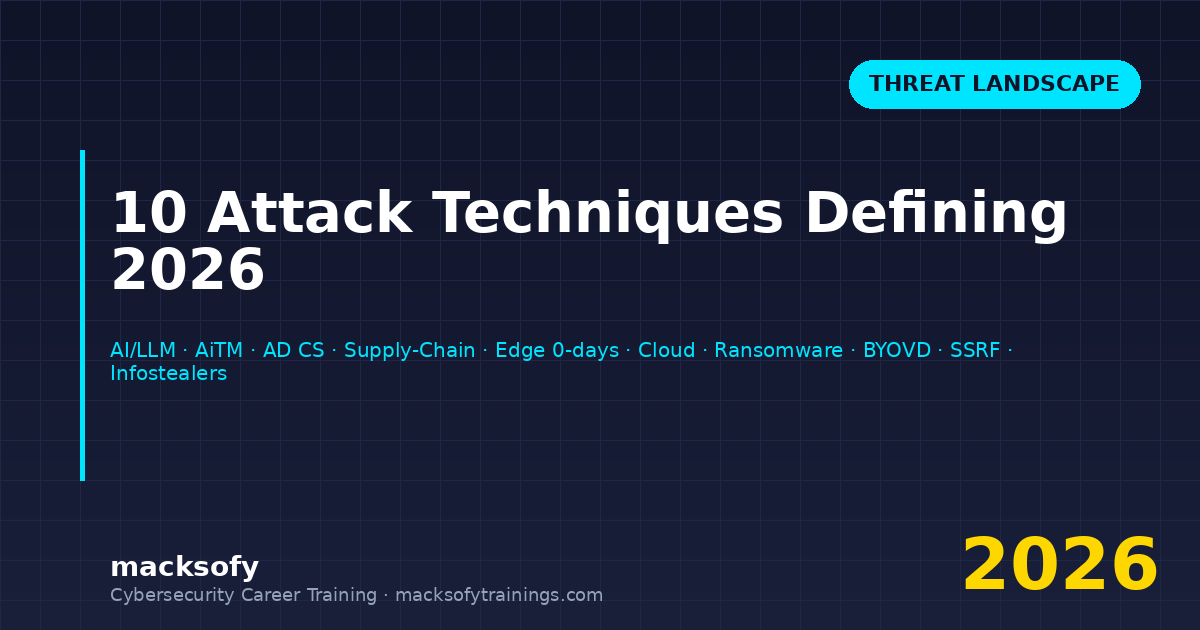
The 10 cyberattack techniques defining 2026, at a glance
Quick answer: The 10 cyberattack techniques defining 2026 are AI & LLM Exploitation, Adversary-in-the-Middle (AiTM) Phishing & MFA Bypass, Active Directory Certificate Services Abuse (AD CS / ESC chains), Software Supply-Chain & CI/CD Pipeline Compromise, Edge & Perimeter Appliance Zero-Days (VPN / Firewall), Cloud Identity Attacks & Privilege Escalation, Ransomware & Multi-Extortion (RaaS), Living-off-the-Land & BYOVD (EDR Evasion), Web Exploitation: SSRF, Insecure Deserialization & Request Smuggling and Infostealers & Initial Access Brokers.
- AI & LLM Exploitation
- Adversary-in-the-Middle (AiTM) Phishing & MFA Bypass
- Active Directory Certificate Services Abuse (AD CS / ESC chains)
- Software Supply-Chain & CI/CD Pipeline Compromise
- Edge & Perimeter Appliance Zero-Days (VPN / Firewall)
- Cloud Identity Attacks & Privilege Escalation
- Ransomware & Multi-Extortion (RaaS)
- Living-off-the-Land & BYOVD (EDR Evasion)
- Web Exploitation: SSRF, Insecure Deserialization & Request Smuggling
- Infostealers & Initial Access Brokers
| # | Attack technique | Category |
|---|---|---|
| 1 | AI & LLM Exploitation | AI / LLM |
| 2 | Adversary-in-the-Middle (AiTM) Phishing & MFA Bypass | Phishing / Identity |
| 3 | Active Directory Certificate Services Abuse (AD CS / ESC chains) | Active Directory |
| 4 | Software Supply-Chain & CI/CD Pipeline Compromise | Supply Chain |
| 5 | Edge & Perimeter Appliance Zero-Days (VPN / Firewall) | Edge Exploitation |
| 6 | Cloud Identity Attacks & Privilege Escalation | Cloud Security |
| 7 | Ransomware & Multi-Extortion (RaaS) | Ransomware |
| 8 | Living-off-the-Land & BYOVD (EDR Evasion) | Evasion |
| 9 | Web Exploitation: SSRF, Insecure Deserialization & Request Smuggling | Web / AppSec |
| 10 | Infostealers & Initial Access Brokers | Threat Intel |
Every year a handful of attack techniques move from research papers and conference stages into the everyday playbooks of real intrusions. Heading into 2026, the threat landscape has tilted decisively toward identity, trust, and automation: attackers increasingly log in rather than break in, abuse the tools and pipelines defenders rely on, and weaponise AI itself. This guide profiles the 10 attack techniques defining cybersecurity in 2026 — what each one is, why it matters now, how it is executed, and how it is tested and defended — with real CVEs and incidents for grounding.
This is a techniques roundup, not a profile of individuals. For each entry we point to the Macksofy course where you can build the hands-on skills to attack and defend it. Macksofy Trainings is an official EC-Council Accredited Training Center; our OffSec and CompTIA programs are independent exam-preparation bootcamps and are not affiliated with or endorsed by those vendors. CVE identifiers and incident references are cited from public security advisories for educational context.
How we chose these 10
A technique earned a place only if it meets at least two of the following: (1) it appears in real, publicly-documented 2024–2026 intrusions or CVEs; (2) it has matured, repeatable tooling; (3) it materially defeats a control defenders previously trusted; and (4) it shows up routinely on professional penetration tests and incident-response engagements in India and globally. We deliberately favoured techniques over fashionable buzzwords.
1. AI & LLM Exploitation — Prompt Injection and Agentic Abuse
Category: AI / LLM. As organisations wire LLMs and autonomous agents into production, prompt injection (direct and indirect) has become the defining new attack class of 2026.
What it is. Prompt injection manipulates a large language model into ignoring its instructions and following attacker-supplied ones instead. Direct injection is typed straight into a chat box; the far more dangerous indirect injection hides instructions inside data the model later reads — a web page, a PDF, an email, a code comment, or a tool’s output. When that model is an agent with tools (browse, send email, run code, query a database, call an MCP server), a single poisoned document can turn the agent into a confused deputy that exfiltrates data or takes destructive actions on the attacker’s behalf.
Why it defines 2026. Prompt injection sits at the top of the OWASP Top 10 for LLM Applications (LLM01). The explosion of agentic frameworks and the Model Context Protocol (MCP) in 2025 turned a research curiosity into a live production risk: any business connecting an AI agent to internal tools inherits an entirely new, hard-to-sanitise input surface. Unlike SQL injection, you cannot fully “escape” natural language — defence is probabilistic, not deterministic, which is exactly why this technique is reshaping appsec.
How attackers execute it. Common patterns: hiding Ignore previous instructions and … payloads in white-on-white text on a web page an agent summarises; poisoning a RAG knowledge base so retrieval returns attacker instructions; abusing over-broad MCP tool permissions to chain “read a file” into “POST it to attacker.com”; and tricking coding agents into writing a backdoor via a malicious dependency README. Data-exfiltration via markdown image rendering () remains a recurring trick.
How it is tested and defended. Treat every LLM input boundary as untrusted, enforce least-privilege on agent tools, require human-in-the-loop confirmation for irreversible actions, isolate retrieved content from the instruction channel, and red-team the model with adversarial prompts before launch. Output filtering and allow-listed egress blunt the exfiltration paths.
Learn the skills. Macksofy’s CEH v13 (AI) program introduces AI-driven attack and defence workflows, and our deep-dives on MCP server security and the OWASP LLM Top 10 walk through these exact failure modes hands-on.
Real-world grounding. The risk became concrete as companies shipped AI assistants that read untrusted content. Researchers repeatedly demonstrated indirect injection against production assistants — a crafted web page or shared document instructing the assistant to leak conversation history or a connected mailbox. With the Model Context Protocol now connecting agents to file systems, ticketing tools, and databases, the blast radius of a single poisoned input scales with the agent’s permissions, not the cleverness of the prompt.
Tester’s checklist. Enumerate every place the model ingests external text (web fetch, RAG store, file upload, tool output); attempt instruction-override and data-exfiltration via markdown/links; verify whether tool calls require confirmation; and confirm egress is allow-listed. The defender’s north star is simple: an LLM should never be the sole authoriser of an irreversible action, and retrieved data should never share a trust channel with system instructions.
2. Adversary-in-the-Middle (AiTM) Phishing & MFA Bypass
Category: Phishing / Identity. Reverse-proxy phishing kits steal live session tokens, neutralising the most common form of multi-factor authentication and driving 2026’s identity-breach wave.
What it is. Adversary-in-the-Middle phishing places an attacker-controlled reverse proxy between the victim and the real login page. The victim authenticates — username, password, and the MFA prompt — against the genuine service, while the proxy silently relays everything and captures the resulting session cookie. With the cookie, the attacker replays an already-authenticated session and skips MFA entirely.
Why it defines 2026. Push-notification and OTP MFA were supposed to end credential phishing. AiTM frameworks such as Evilginx made token theft point-and-click, and phishing-as-a-service kits commoditised it. The result: MFA-bypass via session-token theft is now the dominant path into Microsoft 365 and Google Workspace tenants, frequently chained into business-email-compromise and downstream ransomware.
How attackers execute it. A lookalike domain fronts a reverse proxy templated to the target’s SSO page. Victims arrive via email, SMS, or malicious ads, complete a real login, and the kit harvests the cookie and refresh token. Increasingly, crews pair AiTM with device-code and OAuth consent phishing, which grant long-lived tokens without ever touching a password.
How it is tested and defended. The durable fix is phishing-resistant MFA — FIDO2/WebAuthn passkeys, which cryptographically bind to the real origin and refuse to authenticate against a proxy. Layer conditional-access (device compliance, geo/impossible-travel), short token lifetimes, and continuous session-anomaly detection. Red teams validate this by standing up controlled AiTM infrastructure in authorised engagements.
Learn the skills. Phishing tradecraft and identity-attack chains feature in Macksofy’s CEH v13 social-engineering modules and the offensive path mapped in our red-team certifications guide.
Real-world grounding. AiTM is now the default in large-scale Microsoft 365 intrusions: a finance employee clicks a “shared invoice”, authenticates fully against the real tenant through the proxy, and the attacker replays the stolen cookie minutes later to set inbox rules and launch internal BEC. Because the victim completed a legitimate MFA prompt, logs show a “successful” sign-in — the theft is invisible without token and session analytics.
Tester’s checklist. In authorised engagements, stand up isolated reverse-proxy infrastructure to demonstrate token theft, then validate that conditional-access policies (device compliance, sign-in risk, token-binding) actually block replay. The single highest-impact recommendation you can make to a 2026 client is migrating privileged and high-risk users to FIDO2 passkeys — it is the one control that structurally defeats this technique.
3. Active Directory Certificate Services Abuse (AD CS / ESC chains)
Category: Active Directory. Misconfigured certificate templates let attackers mint domain-admin-equivalent certificates — the defining AD privilege-escalation and persistence technique of the era.
What it is. AD Certificate Services issues the certificates that underpin Windows authentication. A family of misconfigurations catalogued as ESC1 through ESC14 lets an attacker request or forge a certificate that authenticates as a privileged user. Because certificates remain valid even after a password reset, a single ESC abuse becomes stealthy, long-lived domain persistence.
Why it defines 2026. AD CS is deployed in the overwhelming majority of enterprises and was historically ignored by defenders. Since the technique class was popularised, tooling matured (Certify, Certipy) and ESC abuse became a default escalation path on internal engagements — frequently the single finding that converts a foothold into full domain compromise. It dominates real-world Indian enterprise pentests in 2026.
How attackers execute it. Enumerate templates, find one allowing client-authentication with enrollee-supplied subject (ESC1), request a certificate as a domain admin, and authenticate with it via PKINIT to recover a TGT or NTLM hash. Other paths abuse vulnerable CA configuration (ESC6), dangerous access control on templates (ESC4), or NTLM relay to the web-enrollment endpoint (ESC8/ESC11).
How it is tested and defended. Audit every template for enrollee-supplied subjects and over-broad enrol rights, disable web-enrollment where unused, enforce EPA/channel binding, and monitor certificate-request events. Pentesters run Certipy’s find to map the ESC surface before exploiting in a lab-safe manner.
Learn the skills. AD CS abuse and the broader AD kill chain are core to Macksofy’s OSEP exam-prep bootcamp and the OSCP program’s Active Directory sets — reinforced by our AD pentest guide and Windows AD attack cheatsheet.
Real-world grounding. On a typical Indian enterprise internal test, a low-privileged domain user plus one vulnerable certificate template is enough to escalate to Domain Admin in minutes — no software exploit, just a misconfiguration the organisation did not know existed. Because certificates survive password resets, blue teams that “rotate all passwords” after an incident often leave the attacker’s certificate-based access fully intact, which is what makes AD CS abuse such a durable persistence mechanism.
Tester’s checklist. Run a read-only template audit first; report ESC1/ESC4/ESC6/ESC8 exposure with the exact template names; and demonstrate impact in a controlled manner. Defenders should remove enrollee-supplied subjects, tighten template ACLs, enable certificate-request manager approval for sensitive templates, and feed CA logs into the SIEM so anomalous requests are caught early.
4. Software Supply-Chain & CI/CD Pipeline Compromise
Category: Supply Chain. Attackers poison the build, not the app — backdoored dependencies and hijacked CI/CD pipelines became 2026’s highest-leverage breach multiplier.
What it is. Rather than attacking a target directly, adversaries compromise something the target trusts and rebuilds from: an open-source dependency, a build server, a CI/CD pipeline, or a signing key. One poisoned link propagates to every downstream consumer automatically.
Why it defines 2026. The XZ Utils backdoor (CVE-2024-3094) — a multi-year social-engineering operation that planted a hidden SSH backdoor into a core Linux compression library — was a wake-up call: a patient attacker nearly backdoored a huge swath of the internet through a single maintainer. Combined with relentless npm/PyPI typosquatting and dependency-confusion attacks, the build pipeline is now treated as Tier-0 infrastructure.
How attackers execute it. Typosquat or dependency-confusion a package name; socially engineer maintainer access to a real one; steal CI secrets via a malicious pull-request workflow; or abuse over-privileged GitHub Actions tokens to inject code at build time. Self-hosted runners and leaked PAT/cloud-OIDC tokens are favourite footholds.
How it is tested and defended. Pin and verify dependencies (lockfiles, hashes, SLSA provenance), generate and review SBOMs, isolate build runners, scope CI tokens to least privilege, and require signed commits/artifacts. Offensive testing means treating the pipeline itself as an in-scope target.
Learn the skills. Pipeline and infrastructure attack paths build on the enumeration and exploitation foundations in Macksofy’s OSCP bootcamp, extended by the red-team tradecraft in our red-team certifications roadmap.
Real-world grounding. Beyond XZ Utils, 2024–2025 saw sustained npm and PyPI campaigns — typosquatted packages, dependency-confusion uploads, and post-install scripts that exfiltrate environment secrets the instant a build runs. CI/CD is the force multiplier: a single over-privileged GitHub Actions workflow or a leaked cloud-OIDC trust can let a malicious pull request mint production credentials.
Tester’s checklist. Treat the pipeline as in-scope: review workflow permissions, look for pull_request_target misuse, hunt for secrets in build logs and artefacts, and test dependency-confusion against internal package names. Defenders pin and hash dependencies, generate SBOMs, scope tokens to least privilege, isolate runners, and require signed, provenance-attested builds.
5. Edge & Perimeter Appliance Zero-Days (VPN / Firewall)
Category: Edge Exploitation. Internet-facing VPN, firewall, and gateway appliances became the single most-exploited initial-access vector — pre-auth zero-days turn the perimeter into the soft centre.
What it is. Security appliances at the network edge — SSL VPNs, firewalls, secure gateways, file-transfer appliances — run complex code, sit directly on the internet, and are hard to patch without downtime. A pre-authentication vulnerability in one yields an instant, privileged foothold inside the network.
Why it defines 2026. A relentless cadence of high-severity, actively-exploited bugs — Citrix Bleed (CVE-2023-4966), Ivanti Connect Secure (CVE-2023-46805 / CVE-2024-21887), and the Palo Alto PAN-OS GlobalProtect flaw (CVE-2024-3400), among others — proved that the device meant to protect the perimeter is often the way in. Nation-state and ransomware crews now monitor these advisories and weaponise them within hours of disclosure.
How attackers execute it. Mass-scan for exposed appliance versions, fire a pre-auth RCE or auth-bypass, steal session tokens or config (including cached credentials and VPN cookies), then pivot inward. Citrix Bleed, for instance, leaked session tokens straight from memory, enabling MFA-less session hijack.
How it is tested and defended. Minimise internet-exposed management surfaces, subscribe to vendor advisories and patch on an emergency SLA, rotate secrets after any appliance CVE, and segment so an edge compromise does not equal domain compromise. Pentesters fingerprint edge devices first — they are the highest-ROI target.
Learn the skills. Service enumeration, version fingerprinting, and exploitation workflow are the backbone of Macksofy’s OSCP and CPENT programs; sharpen recon with our top penetration-testing tools roundup.
Real-world grounding. Citrix Bleed (CVE-2023-4966) let attackers pull session tokens straight from appliance memory and hijack already-authenticated sessions without credentials or MFA — and it was mass-exploited by ransomware affiliates for months. The Ivanti Connect Secure chain (CVE-2023-46805 / CVE-2024-21887) and the PAN-OS GlobalProtect flaw (CVE-2024-3400) told the same story: the device guarding the perimeter became the breach.
Tester’s checklist. Fingerprint every internet-facing appliance and its exact firmware version, cross-reference live advisories, and flag anything behind on emergency patches. Recommend reducing exposed management interfaces, rotating all secrets after any appliance CVE (tokens persist post-patch), and segmenting so an edge compromise cannot reach domain controllers directly.
6. Cloud Identity Attacks & Privilege Escalation
Category: Cloud Security. In the cloud, identity is the new perimeter — stolen tokens, over-permissioned roles, and SSRF-to-metadata chains drove the defining cloud breaches of 2026.
What it is. Cloud attacks rarely “break in” through a kernel exploit; they log in. Adversaries abuse leaked access keys, OAuth/refresh tokens, over-broad IAM roles, and misconfigured trust relationships to escalate from a low-privilege identity to tenant-wide control across AWS, Azure, and GCP.
Why it defines 2026. The 2024 wave of attacks against a major cloud-data-warehouse provider’s customers — where infostealer-harvested credentials walked into accounts that lacked MFA — showed that one weak identity can expose enormous data estates. As workloads consolidate in the cloud, IAM misconfiguration has overtaken network flaws as the primary breach driver.
How attackers execute it. Harvest keys from leaked .env files, public buckets, or CI logs; abuse SSRF to hit the instance metadata service (IMDS) and steal role credentials; ride a permissive AssumeRole or service-principal consent grant laterally; and enumerate iam:PassRole or function-update paths to privilege-escalate. Persistence often hides in new IAM users, access keys, or OAuth app registrations.
How it is tested and defended. Enforce MFA everywhere, prefer short-lived federated credentials over static keys, require IMDSv2, right-size IAM with access analyzers, and alert on anomalous role assumption. Cloud pentesters map the identity graph before touching a single host.
Learn the skills. Macksofy’s cloud penetration testing guide (AWS/Azure/GCP) and the multi-cloud escalation paths layered on top of OSCP fundamentals cover exactly these chains.
Real-world grounding. The 2024 attacks against a major cloud data-warehouse provider’s customers were textbook: infostealers had harvested employee credentials months earlier, the targeted accounts lacked MFA, and attackers simply logged in and exported enormous datasets. No exploit, no malware on the warehouse — just unmanaged identity. It is the clearest proof that in the cloud, identity misconfiguration is the breach.
Tester’s checklist. Map the IAM graph before touching hosts; hunt for long-lived access keys in code, buckets, and CI; test SSRF paths to IMDS; and enumerate role-assumption and PassRole escalation chains. Defenders enforce MFA universally, require IMDSv2, replace static keys with short-lived federation, and run access analysers to prune unused permissions.
7. Ransomware & Multi-Extortion (RaaS)
Category: Ransomware. Ransomware-as-a-Service industrialised intrusion, and double/triple extortion made data theft — not just encryption — the real leverage of 2026.
What it is. Modern ransomware is a business model. Ransomware-as-a-Service operators build the malware and leak sites; affiliates do the breaking-in and share the proceeds. Crucially, crews now exfiltrate data before encrypting (double extortion) and add DDoS or direct customer/regulator harassment (triple extortion), so paying for a decryptor no longer buys silence.
Why it defines 2026. RaaS lowered the skill floor and scaled the volume; the data-theft pivot defeated the “good backups” defence that once neutralised ransomware. High-profile takedowns of major brands proved disruptive but the affiliate model simply re-formed under new names — the technique, not any one gang, is what endures.
How attackers execute it. Initial access via phishing, edge zero-days, or bought infostealer credentials; then living-off-the-land lateral movement, AD/domain compromise, backup destruction, bulk exfiltration to cloud storage, and finally encryption. Dwell time has shrunk as playbooks have standardised.
How it is tested and defended. Defence is detection-and-response plus resilience: immutable offline backups, network segmentation, EDR with behaviour analytics, rapid patching of the access vectors above, and a rehearsed incident-response plan. Purple-team exercises validate that detections actually fire.
Learn the skills. The blue-team and incident-response side maps to Macksofy’s SOC-200 (OSDA) and Certified SOC Analyst programs, with formal handling in EC-Council ECIH.
Real-world grounding. Even after coordinated law-enforcement takedowns of major ransomware brands, the affiliate model simply re-branded and continued — proof that the RaaS technique, not any single gang, is the durable threat. The shift to data theft before encryption is what defeated the old “we have backups” confidence: restoring systems does nothing to stop the leak-site countdown on your stolen data.
Tester’s checklist. Purple-team the full chain — initial access, lateral movement, backup destruction, exfiltration — and confirm each stage generates a detection that actually alerts. Defenders need immutable offline backups, segmentation that contains lateral movement, EDR behaviour analytics, exfiltration monitoring on large outbound transfers, and a rehearsed, role-assigned incident-response plan.
8. Living-off-the-Land & BYOVD (EDR Evasion)
Category: Evasion. Attackers blend in with legitimate tools and disable defences with signed-but-vulnerable drivers — the defining stealth technique of 2026.
What it is. Living-off-the-Land (LOTL) abuses tools already present and trusted on the host — PowerShell, WMI, certutil, rundll32, scheduled tasks (the “LOLBins”) — so malicious activity looks like normal administration. Bring-Your-Own-Vulnerable-Driver (BYOVD) goes further: the attacker loads a legitimately-signed but vulnerable kernel driver to disable or blind EDR from below.
Why it defines 2026. As endpoint detection improved, attackers shifted from dropping obvious malware to abusing trust. BYOVD in particular neutralises the very tools defenders rely on, and the supply of abusable signed drivers (catalogued by projects like LOLDrivers) keeps the technique evergreen. Stealth — not novelty — is the 2026 differentiator.
How attackers execute it. Chain LOLBins for download, execution, and persistence without writing custom binaries; use a vulnerable driver to terminate AV/EDR processes or strip kernel callbacks; and stage payloads in memory to avoid disk-based detection. Defenders see “PowerShell ran” and “a signed driver loaded” — both individually benign.
How it is tested and defended. Deploy Microsoft’s vulnerable-driver blocklist and WDAC, constrain PowerShell (Constrained Language Mode, script-block logging), hunt on behaviour rather than signatures, and alert on unusual parent-child process trees. Red teams emulate these chains to test whether detections survive evasion.
Learn the skills. Defence-evasion tradecraft is central to Macksofy’s OSEP exam-prep bootcamp; the detection side is covered in SOC-200.
Real-world grounding. Ransomware and espionage crews routinely ship a vulnerable signed driver alongside their tooling specifically to kill EDR before detonating a payload — the LOLDrivers project now catalogues hundreds of abusable drivers. Paired with LOLBins for download and execution, an entire intrusion can complete without a single unsigned binary touching disk, which is exactly why behaviour-based detection has overtaken signatures.
Tester’s checklist. Emulate LOLBin chains and (in a lab) BYOVD EDR-unhooking to measure detection coverage, then report which behaviours went unseen. Defenders deploy Microsoft’s vulnerable-driver blocklist and WDAC, constrain PowerShell with Constrained Language Mode and script-block logging, and hunt on anomalous parent-child process trees rather than file hashes.
9. Web Exploitation: SSRF, Insecure Deserialization & Request Smuggling
Category: Web / AppSec. Server-side web flaws — SSRF, deserialization RCE, and HTTP request smuggling — remain the highest-impact application bugs heading into 2026.
What it is. Three server-side classes do outsized damage. SSRF coerces a server into making attacker-chosen requests — reaching internal services and cloud metadata. Insecure deserialization turns attacker-controlled serialized objects into remote code execution. HTTP request smuggling exploits parser disagreements between front-end and back-end to desync the connection and poison other users’ requests.
Why it defines 2026. SSRF is the connective tissue of cloud breaches (it is the usual route to IMDS credential theft). Deserialization and injection remain the engine behind mass-exploitation events — the MOVEit Transfer SQL-injection campaign (CVE-2023-34362) compromised thousands of organisations through a single web flaw. These are not legacy bugs; they scale.
How attackers execute it. Probe URL-fetch features and webhooks for SSRF, then pivot to 169.254.169.254; feed crafted serialized blobs to vulnerable endpoints for RCE; and exploit CL.TE/TE.CL ambiguities to smuggle requests past front-end controls. White-box source review accelerates all three.
How it is tested and defended. Allow-list outbound requests and block link-local ranges, avoid native deserialization of untrusted input (use safe formats and integrity checks), normalise HTTP parsing across the stack, and fuzz aggressively. Code review plus Burp-driven testing is the standard workflow.
Learn the skills. White-box web exploitation and source-code review are the heart of Macksofy’s OSWE (WEB-300) bootcamp; start the workflow with our Burp Suite for beginners guide.
Real-world grounding. The MOVEit Transfer SQL-injection campaign (CVE-2023-34362) compromised thousands of organisations and tens of millions of individuals through one web vulnerability in a widely-used file-transfer app — a reminder that “boring” server-side bugs still drive the largest mass-exploitation events. SSRF, meanwhile, is the connective tissue of cloud breaches because it is the usual route to stealing instance-metadata credentials.
Tester’s checklist. Hunt URL-fetch features, webhooks, and PDF/image processors for SSRF; test deserialization sinks with safe proof-of-concept gadgets; and probe front-end/back-end parser disagreements for request smuggling. White-box source review accelerates discovery — exactly the OSWE workflow. Defenders allow-list egress, avoid native deserialization of untrusted input, and normalise HTTP parsing across the stack.
10. Infostealers & Initial Access Brokers
Category: Threat Intel. Commodity infostealer malware feeds a credential marketplace that fuels nearly every other technique on this list — the quiet engine of the 2026 breach economy.
What it is. Infostealers are cheap, commodity malware (Lumma, RedLine, and successors) that grab saved passwords, session cookies, crypto wallets, and autofill data the moment they run. Initial Access Brokers (IABs) aggregate those harvested credentials and accesses and sell them on criminal markets to ransomware crews and other actors.
Why it defines 2026. This is the supply chain of cybercrime. The cloud-identity and ransomware breaches above frequently start with a credential bought for a few dollars — stolen by an infostealer from an employee’s personal device months earlier. Stolen session cookies are especially potent because they sail past MFA, tying this technique directly to the AiTM problem.
How attackers execute it. Distribute stealers via cracked software, malvertising, fake updates, and “ClickFix” social engineering; harvest browser secrets; package “logs” by company domain; and list corporate accesses on broker channels. Buyers skip the break-in entirely and log straight in.
How it is tested and defended. Defence spans hardening and intelligence: phishing-resistant MFA, short session lifetimes and token revocation, blocking unmanaged devices, dark-web/credential-leak monitoring, and fast response when employee credentials surface. Threat-intel teams track stealer logs as an early-warning signal.
Learn the skills. Tracking this ecosystem is the discipline of Macksofy’s Certified Threat Intelligence Analyst (CTIA) program, complemented by the monitoring workflows in Certified SOC Analyst.
Real-world grounding. The credential that opens a multi-million-dollar breach often costs the attacker a few dollars — stolen months earlier by an infostealer from an employee’s personal laptop and resold by an access broker. Stolen session cookies are the most prized output because they bypass MFA entirely, which is why this commodity-malware ecosystem quietly underwrites the cloud-identity and ransomware techniques higher on this list.
Tester’s checklist. Threat-intel teams monitor stealer-log marketplaces and credential-leak feeds for their own domains as an early-warning system. Defenders pair phishing-resistant MFA with short session lifetimes and aggressive token revocation, block access from unmanaged devices, and treat any appearance of corporate credentials in stealer logs as an incident — not a curiosity.
Frequently Asked Questions
What is the most dangerous attack technique in 2026?
There is no single winner, but identity-centric attacks — AiTM phishing that steals session tokens and infostealer-fuelled credential abuse — cause the most real-world breaches because they bypass MFA and feed ransomware. AI/LLM prompt injection is the fastest-growing new class as agentic AI reaches production.
Are these attack techniques relevant to Indian organisations?
Yes. Active Directory Certificate Services abuse, edge-appliance zero-days, cloud identity escalation, and ransomware appear routinely on penetration tests and incident-response engagements across Indian BFSI, IT services, and enterprise environments. The techniques are vendor- and geography-agnostic.
Which Macksofy course should I take to learn offensive techniques?
For network and Active Directory attacks, start with OSCP and progress to OSEP. For web and source-code exploitation, OSWE. For a broad ethical-hacking foundation including AI-driven attacks, CEH v13. See our post-OSCP roadmap at https://www.macksofytrainings.com/after-oscp-next-certifications-india-2026/ for sequencing.
Which course covers the defensive (blue-team) side?
SOC-200 (OSDA) and EC-Council Certified SOC Analyst (CSA) cover detection and security operations; ECIH covers structured incident handling; and CTIA covers threat intelligence and tracking ecosystems like infostealers and access brokers.
Does MFA still protect against phishing in 2026?
Standard push/OTP MFA is increasingly bypassed by Adversary-in-the-Middle kits that steal live session tokens. Phishing-resistant MFA — FIDO2/WebAuthn passkeys bound to the real origin — remains effective because it refuses to authenticate against a proxy.
What is BYOVD and why is it hard to stop?
Bring-Your-Own-Vulnerable-Driver loads a legitimately-signed but flawed kernel driver to disable or blind EDR from the kernel. It is hard to stop because the driver is validly signed; defence relies on vulnerable-driver blocklists, WDAC, and behaviour-based hunting rather than signatures.
How do supply-chain attacks like XZ Utils happen?
Attackers compromise something the target trusts and rebuilds from — an open-source dependency, a maintainer account, a CI/CD pipeline, or a signing key. The XZ Utils backdoor (CVE-2024-3094) was a multi-year social-engineering effort to plant a hidden SSH backdoor in a core Linux library.
Are CVEs and incidents in this guide real?
Yes. Every CVE identifier (for example CVE-2024-3094 XZ Utils, CVE-2023-4966 Citrix Bleed, CVE-2024-3400 PAN-OS, CVE-2023-34362 MOVEit) and incident reference is drawn from public security advisories and is provided for educational context only.
Turn the threat landscape into a skill set
Understanding these ten techniques is the first step; being able to execute and defend against them in a lab is what employers pay for. Macksofy’s hands-on bootcamps — OSCP, OSEP, OSWE, CEH v13, CPENT, CSA, SOC-200, and CTIA — map directly onto the offensive and defensive sides of this list, with real lab environments and placement assistance across India.
Disclaimer: This article is for educational and defensive-awareness purposes. All CVE identifiers and incidents are cited from public advisories. Macksofy Trainings is an EC-Council Accredited Training Center; OffSec and CompTIA programs are independent exam-prep bootcamps not affiliated with those vendors. Always operate only within authorised, legal scope.
Related deep-dive: new to AI/LLM attack surface? Start with our OWASP Top 10 for LLM applications series, including LLM02: Sensitive Information Disclosure.
