


Getting Started in Industrial Cybersecurity: A Practical Guide for OT Professionals
Industrial cybersecurity has become a mission-critical discipline as ICS and OT environments rapidly connect to enterprise IT and the internet. What was once isolated is now exposed, and attackers are actively exploiting this shift.
For OT engineers, automation professionals, plant operators, and control system specialists, understanding ICS/OT cybersecurity is no longer optional—it is essential to protecting safety, operations, and critical infrastructure.
This guide explains industrial cybersecurity fundamentals, highlights real-world ICS cyber threats, and provides a clear roadmap for professionals entering OT cybersecurity.
What Is Industrial Cybersecurity (ICS/OT Security)?
Industrial cybersecurity, also known as ICS cybersecurity or OT cybersecurity, focuses on protecting industrial control systems such as:
-
PLCs and RTUs
-
Distributed Control Systems (DCS)
-
Safety Instrumented Systems (SIS)
Unlike traditional IT security, ICS/OT security directly impacts physical processes, making failures potentially catastrophic.
Industrial cybersecurity protects:
-
Human life and physical safety
-
Environmental systems
-
Continuous industrial operations
-
Critical national infrastructure
Why ICS/OT Cybersecurity Is Critical Today
Modern OT networks are no longer air-gapped. Remote access, cloud connectivity, IIoT devices, and vendor integrations have significantly expanded the ICS attack surface.
Key reasons industrial cybersecurity is now critical:
-
Ransomware groups actively target OT environments
-
Most ICS attacks originate from IT networks
-
Downtime can cause physical damage and safety risks
-
Regulatory pressure is increasing globally
In OT cybersecurity, the reality is simple:
It’s not a question of if an ICS attack will happen, but when.
IT vs OT Security: Understanding the Key Differences
Many professionals struggle when transitioning from IT to OT security because the security objectives are fundamentally different.
IT Cybersecurity Priorities
-
Confidentiality
-
Integrity
-
Availability
OT Cybersecurity Priorities
-
Physical safety
-
Environmental protection
-
Operational continuity
-
Integrity and confidentiality
In ICS/OT environments, a simple action like patching or scanning—routine in IT—can disrupt operations or create safety hazards.
This difference is why industrial cybersecurity requires specialized knowledge, not just traditional IT skills.
Real-World ICS Cyber Attacks You Should Know
Understanding past ICS cyber incidents is essential to appreciating the real-world impact of OT cybersecurity failures.
Notable incidents include:
-
Stuxnet – Malware designed to physically destroy industrial equipment
-
Ukraine Power Grid Attacks – OT cyberattacks caused nationwide blackouts
-
Triton/Trisis – Malware targeted Safety Instrumented Systems
-
Colonial Pipeline – IT ransomware caused OT shutdown and fuel shortages
Each event demonstrates that industrial cybersecurity incidents have physical, economic, and societal consequences.
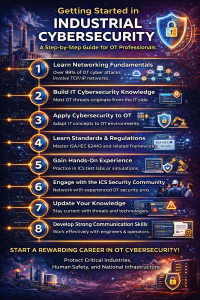
Roadmap to Start a Career in OT Cybersecurity
If you are serious about entering ICS/OT cybersecurity, follow this structured approach.
1. Learn Networking Fundamentals for ICS
Over 99% of ICS cyberattacks involve traditional IT assets and TCP/IP networks.
OT professionals must understand:
-
IT networks vs OT networks
-
How the internet, IT, and OT environments interact
-
TCP and UDP communication fundamentals
Strong networking knowledge is the foundation of industrial cybersecurity.
2. Master IT Cybersecurity Basics
Most attacks against OT systems begin in the IT environment.
You must understand:
-
How attackers gain initial access
-
How malware spreads into OT networks
-
How detection and response works
Without IT cybersecurity fundamentals, OT cybersecurity defenses will fail.
3. Apply Cybersecurity Concepts to OT Safely
Security controls must be adapted for OT, not copied from IT.
Key considerations:
-
Avoid operational disruptions
-
Maintain safety and availability
-
Use monitoring over active scanning
Effective ICS security balances protection with operational reality.
4. Learn Industrial Cybersecurity Standards
Standards provide structure and credibility in OT cybersecurity.
Key frameworks include:
-
ISA/IEC 62443
-
NIST SP 800-82
-
CISA ICS guidance
Understanding these standards is essential for industrial cybersecurity engineers.
5. Gain Hands-On ICS Security Experience
Theory alone is not enough.
Hands-on experience should include:
-
ICS lab environments
-
Network segmentation exercises
-
Incident detection scenarios
Practical exposure builds real OT cybersecurity skills.
6. Engage With the ICS/OT Security Community
The ICS cybersecurity community is collaborative and knowledge-driven.
Benefits include:
-
Learning from real incidents
-
Staying current with threats
-
Access to mentors and practitioners
Community involvement accelerates growth in industrial cybersecurity careers.
7. Stay Current With OT Cyber Threats
ICS threats evolve constantly.
Professionals must:
-
Track emerging malware
-
Follow ICS advisories
-
Understand attacker tactics
Continuous learning is mandatory in OT cybersecurity.
8. Build Strong Communication and Soft Skills
OT cybersecurity professionals must communicate across teams:
-
Engineers
-
Operators
-
Management
Clear communication is critical for successful industrial cybersecurity programs.
9. Earn Relevant Industrial Cybersecurity Certifications
Industrial cybersecurity Certifications validate foundational knowledge.
A strong starting point:
-
Macksofy Trainings OT Security Training – Builds core IT cybersecurity skills
Certifications support credibility in ICS/OT cybersecurity roles.
Final Thoughts: Why Industrial Cybersecurity Matters
Industrial cybersecurity protects the invisible systems that power modern life.
For OT professionals, entering ICS/OT cybersecurity means taking responsibility for:
-
Human safety
-
Environmental protection
-
Critical infrastructure resilience
With the right foundation, mindset, and continuous learning, OT cybersecurity offers one of the most impactful careers in cybersecurity today.
IT security vs OT security: why industrial environments need a different playbook
Industrial control systems (ICS) and operational technology (OT) — the PLCs, SCADA systems and HMIs that run power grids, water treatment, oil & gas and manufacturing lines — cannot be secured the way a corporate IT network is. The priorities are inverted: in IT, confidentiality usually comes first; in OT, availability and safety come first, because an outage or a misfired actuator can stop production or endanger people.
Key differences at a glance
- Patching: IT systems patch on a routine cycle; OT systems often run for years without downtime windows, so compensating controls and segmentation matter more than rapid patching.
- Protocols: OT speaks Modbus, DNP3, PROFINET and OPC — mostly designed before authentication was a concern, so network visibility and anomaly detection do the heavy lifting.
- Lifespan: OT hardware can stay in service 15–25 years, long past vendor support.
- Impact: a successful OT attack can have physical and safety consequences, not just data loss.
The frameworks that matter
Three references anchor most OT security programmes: the Purdue Model for network segmentation between enterprise and control zones; IEC 62443, the international standard for industrial automation and control system security; and NIST SP 800-82, the US guide to ICS security that is widely used as a practical baseline. In India, CERT-In advisories and sector regulators increasingly expect critical-infrastructure operators to demonstrate this kind of structured OT risk management.
Common OT attack scenarios
Real incidents have ranged from purpose-built malware that manipulated centrifuge controllers, to commodity ransomware jumping from a corporate IT network into a flat OT network and forcing a production shutdown, to remote access into an exposed engineering workstation. The recurring theme is an under-segmented boundary between IT and OT — which is exactly why monitoring and zoning are the first wins in any OT programme.
Building OT security skills in India
OT security demand in India is concentrated in power and utilities, oil & gas, pharma manufacturing, automotive and water infrastructure. A practical path is to first build defensive SOC fundamentals (log analysis, ATT&CK, detection engineering), then layer on ICS/OT-specific knowledge: protocols, the Purdue Model and IEC 62443. Analysts who can bridge a corporate SOC and a plant-floor network are scarce and well paid.
Related reading
- SOC-200 (OSDA) defensive analysis
- Certified SOC Analyst (CSA) course
- CTIA threat-intelligence training
- 10 attack techniques defining 2026
- the CERT-In cybersecurity checklist for MSMEs
- lessons from the CrowdStrike Windows outage
- all cybersecurity courses
