


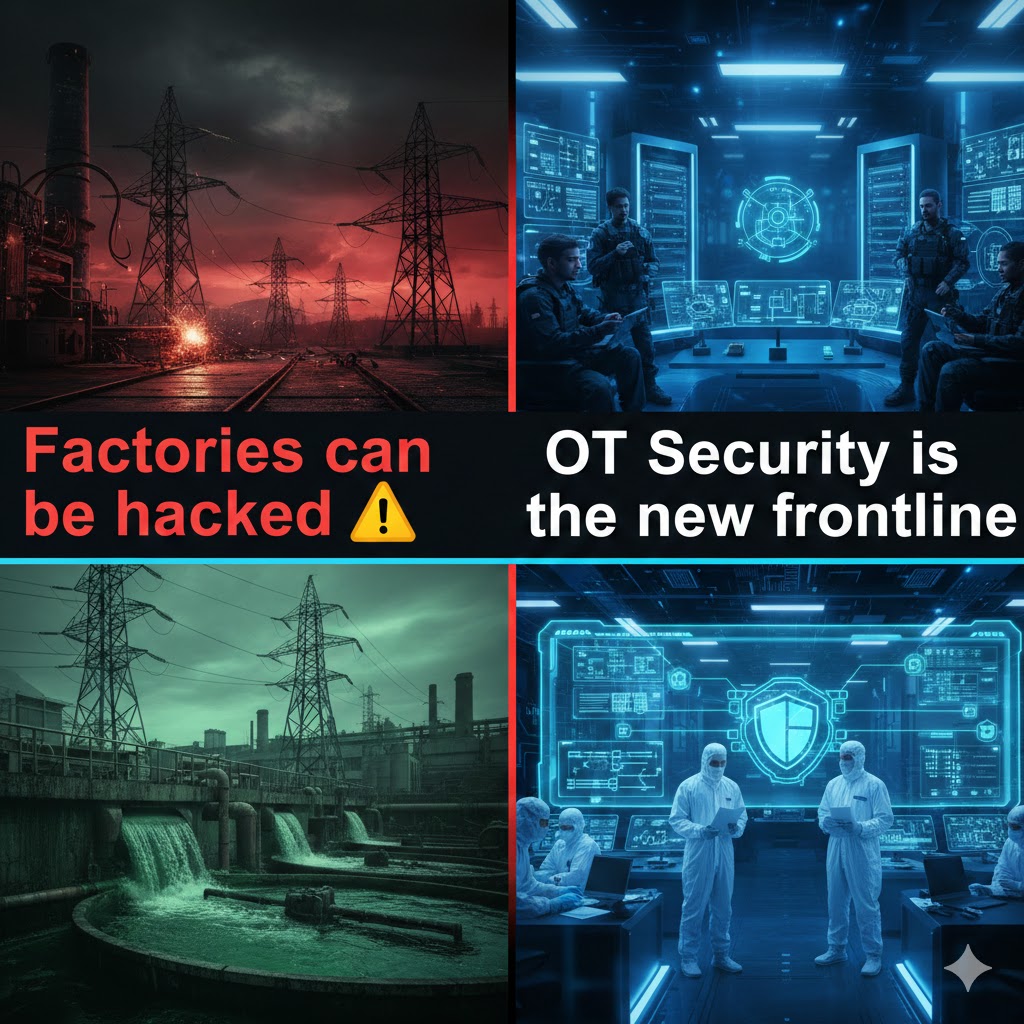
OT Security Needs in the Latest Cyber Threat Era: A Detailed Guide for 2026
OT security needs in the latest cyber threat era have escalated dramatically as industrial environments adopt remote access, IIoT, cloud connectivity, and IT–OT convergence. Threat actors now target factories, power grids, oil & gas facilities, and water utilities because disrupting physical operations creates massive financial and safety impact. Unlike IT breaches that primarily expose data, OT cyber incidents can halt production, damage equipment, and endanger human lives.
What Is OT Security?
OT (Operational Technology) security is the practice of protecting industrial control systems (ICS), SCADA servers, PLCs, RTUs, HMIs, and industrial networks from cyber attacks that can disrupt physical processes, cause safety incidents, or shut down critical infrastructure.
Why OT Security Is More Critical Than Ever in 2026
1) IT–OT Convergence Has Expanded the Attack Surface
Smart factories, remote operations, and cloud dashboards expose OT environments to IT-borne threats. Jump servers, VPNs, and APIs become high-risk pivot points.
2) Ransomware Now Targets Operations
Modern ransomware groups aim to stop production, not just steal data—forcing organizations to pay to restore operations.
3) Legacy OT Protocols Lack Security by Design
Protocols like Modbus, DNP3, and older OPC lack authentication and encryption. If reachable, attackers can issue write commands.
4) Third-Party & Supply Chain Risk
Integrators, vendors, and MSPs often maintain persistent access into OT DMZs—creating attractive entry points.
5) Regulatory & Insurance Pressure
Frameworks like NIST SP 800-82, IEC 62443, and CERT-In expectations are now influencing audits, contracts, and cyber-insurance premiums.
Modern OT Threat Landscape (Who Attacks OT and Why)
-
Ransomware groups – monetize downtime
-
Nation-state actors – espionage, sabotage
-
Insiders – misuse access
-
Hacktivists – disruption for visibility
-
Supply-chain attackers – compromise vendors to reach plants
Motives: financial extortion, disruption, espionage, geopolitical pressure.
Realistic OT Attack Paths Seen in the Wild
-
Phishing → IT foothold → OT pivot via jump servers
-
Compromised VPN/RDP into OT DMZ
-
Protocol misuse (Modbus write coils/registers)
-
HMI ransomware blinds operators
-
PLC logic tampering disrupts physical processes
-
Historian manipulation falsifies telemetry
-
Credential reuse across IT and OT
OT vs IT Security: Key Differences That Break Traditional Defenses
| Area | IT Security | OT Security |
|---|---|---|
| Availability | Important | Critical (safety & uptime) |
| Patching | Frequent | Rare, controlled windows |
| Scanning | Active OK | Passive preferred |
| Protocols | TLS/HTTPS | Modbus/DNP3 (legacy) |
| Change Mgmt | Agile | Strict, safety-reviewed |
Takeaway: Copy-pasting IT playbooks into OT causes outages and blind spots.
Practical OT Security Architecture (What “Good” Looks Like)
Network & Access
-
Purdue Model segmentation (IT → OT DMZ → OT Zone)
-
No direct internet from OT
-
Bastion hosts + MFA for remote access
-
Least-privilege roles for engineers/operators
Detection & Monitoring
-
ICS-aware IDS (Zeek/Suricata) with protocol rules
-
OT SOC dashboards (Wazuh + SIEM)
-
Port mirroring of OT switches
-
Alerts for Modbus writes, OPC-UA session spikes
Hardening & Resilience
-
PLC logic backups + change alerts
-
HMI application allowlisting
-
Secure configuration baselines
-
Offline recovery images
Incident Response for OT Security
-
Safety-first IR playbooks
-
Kill-switch for OT writes
-
Tabletop exercises for plant managers
-
Coordination with CERT-In/NCIIPC where applicable
Compliance & Governance for OT Environments
-
NIST SP 800-82: ICS security guidance
-
IEC 62443: OT product/system lifecycle security
-
CERT-In advisories: India-specific expectations
-
Risk assessments: map safety impact, downtime cost
-
Policies: remote access, change control, vendor access
OT Security Tooling
-
IDS: Zeek, Suricata (ICS rules)
-
SIEM/SOC: Wazuh + Elastic
-
Asset Discovery: passive ICS discovery
-
Access Control: bastion + MFA
-
Backup/DR: PLC logic & HMI images
-
Deception (optional): OT honeypots for early warning
Skills & Careers in OT Security
In-demand skills:
-
ICS protocol analysis (Modbus, OPC-UA)
-
OT network segmentation
-
PLC/SCADA hardening
-
Detection engineering for ICS
-
OT incident response
Roles:
-
OT Security Engineer
-
ICS Security Consultant
-
Industrial SOC Analyst
-
Critical Infrastructure Security Specialist
OT specialists command premium salaries due to talent scarcity.
Why Hands-On OT Security Training Is Non-Negotiable
PowerPoint doesn’t prepare teams for real plants. Effective training includes:
-
Digital-twin SCADA/PLC labs
-
Red vs Blue OT simulations
-
MITRE ATT&CK for ICS mapping
-
Incident response drills
-
Compliance mapping exercises
👉 Macksofy Trainings offers hands-on OT security programs with real industrial labs (powered by LearnToExploit) to help teams safely practice attack, detection, and defense.
FAQs
What is OT security?
OT security protects industrial systems (ICS/SCADA/PLCs) from cyber attacks that can disrupt physical operations and safety.
Why is OT security difficult?
Legacy protocols, safety constraints, and limited patch windows require passive monitoring and careful change control.
What are the top OT threats today?
Ransomware, remote access abuse, protocol misuse (Modbus writes), and IT→OT pivoting.
How do I start OT security?
Segment networks, deploy ICS-aware IDS, secure remote access, back up PLC logic, and run OT incident response drills.
Protect operations before attackers test them.
Build OT security skills with Macksofy Trainings—hands-on labs, real scenarios, real outcomes.
